Nerdle
The math Wordle — guess the hidden eight-tile equation in six tries. Unlimited equations, no daily wait, no signup.
What Is Nerdle?
Nerdle is the math version of Wordle. Instead of a five-letter word, you guess a hidden eight-character equation — such as 48-32=16 — in six tries, using green, purple, and gray feedback after every guess.
Each row holds eight tiles built from the digits 0-9 and the symbols + - * / and =. The twist that makes Nerdle a real number puzzle is that every guess has to be a genuine, correct equation: both sides must be equal, or the game rejects it. Green means a tile is in the right spot, purple means it belongs in the equation but sits in the wrong place, and gray means it is not in the equation at all. You can play Nerdle unlimited times here in any modern browser, with no app and no account.
Where Wordle rewards vocabulary, Nerdle rewards logic and quick mental arithmetic — which is why it has become the go-to daily brain workout for people who love numbers.
How to Play Nerdle in 5 Steps
- 01 Type a valid equation. Fill all eight tiles with an equation made of digits 0-9 and the symbols + - * / and =, for example 48-32=16.
- 02 Press Enter to submit. Your guess must be arithmetically correct — both sides must be equal — or it will be rejected. Only real equations count.
- 03 Read the color clues. Green means the digit or symbol is in the right spot, purple means it is in the equation but in the wrong place, and gray means it is not in the equation at all.
- 04 Narrow it down in six tries. Use the colors to deduce the hidden equation. Lock in the greens, move the purples, and rule out the grays — you have six guesses.
- 05 Start a new Nerdle instantly. Win or lose, hit New Game for a fresh equation. No daily reset, no waiting — play Nerdle unlimited times.
Nerdle vs Wordle
Nerdle keeps Wordle's guess-and-deduce loop but swaps words for math. Here is how they line up:
| Feature | Nerdle | Wordle |
|---|---|---|
| You guess | An 8-tile equation | A 5-letter word |
| Tiles | Digits 0-9 and + - * / = | Letters A-Z |
| Guesses | 6 | 6 |
| Colors | Green / purple / gray | Green / yellow / gray |
| Each guess must be | A true equation | A real word |
| Skill tested | Logic & arithmetic | Vocabulary |
The biggest practical difference is that Nerdle checks your math: a guess that is not a valid equation will not be accepted, so every line you spend is a real, balanced equation working toward the answer.
What Counts as a Valid Equation
Nerdle only accepts guesses that are mathematically correct. Knowing the constraints both gets your guesses accepted and lets you rule out impossible answers:
- Exactly one equals sign. Every equation has one =, and the right side must be a single number (no operations after the =).
- Both sides must be equal. 48-32=16 works; 48-32=15 is rejected as "doesn't compute".
- Order of operations applies. Multiplication and division are calculated before addition and subtraction, so 2+3*4=14.
- No leading zeros. A number cannot start with 0, so 06+1=7 is invalid (but a result of 0, like 5-5=0, is fine).
- Division must be whole. 8/4=2 is allowed; a division that leaves a fraction is not.
- The answer is never negative. The hidden equation's result is always zero or positive, so you can rule out negatives.
The Best Nerdle Starting Equations
A strong opener tests many different digits and at least two operators at once. We analyzed our pool of 17,447 valid equations and found that the digit 1 is the most common, the minus sign is the most frequent operator, and the equals sign most often sits in position 6 (a five-character left side and a two-digit result).
That points to subtraction-based openers with a two-digit answer. These equations are all valid and make strong, information-rich first guesses:
📝 Why these work: an opener like 48-32=16 tests six different digits plus a minus and an equals in one line. Because the minus sign appears in the most answers and two-digit results are the most common shape, a subtraction opener tends to turn the most tiles green or purple on guess one. Mixing in a division opener on guess two (the remainder constraint is very revealing) narrows the field fast.
Watch a Nerdle Get Solved
Here is a round solved in three guesses. The hidden equation is 48-32=16.
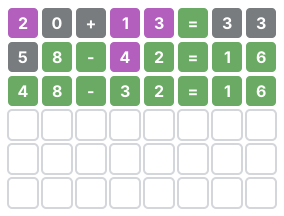
The first guess fixes the equals sign and reveals that 1, 2, and 3 all belong somewhere. The second locks the structure and the result 16. By the third line, the only equation that fits every clue is 48-32=16 — all green.
5 Tips to Win More Nerdle Games
- 01Open with two operators and many digits. A first guess that tests a minus and a division at once reveals both which symbols exist and where the equals sign sits.
- 02Find the equals sign early. Its position tells you the shape of the answer — a green = in position 6 means a five-tile left side and a two-digit result.
- 03Use the constraints. No leading zeros, no negative answers, and whole-number division eliminate huge numbers of possibilities before you even guess.
- 04Don't waste purple tiles. A purple digit or symbol is confirmed to be in the equation — your next guess should move it to a new position, not drop it.
- 05Do the arithmetic before you submit. An invalid equation is rejected and costs you nothing — but a careless one wastes your turn. Double-check both sides balance.